
Magnolia ZIP Market Context · August 2026
In August 2026, 685 homes were listed for sale across the Magnolia area (ZIP 77354, 77355), 196 of them newly listed. Median asking prices ran from $424,450 to $445,213 depending on the ZIP code, and the typical listing had been for sale 44 to 51 days.
| ZIP | Median asking price | Homes for sale | Median days on market |
|---|---|---|---|
| 77354 | $424,450 | 426 | 51 |
| 77355 | $445,213 | 259 | 44 |
Asking prices for homes currently listed across the whole ZIP code, from Realtor.com Research, saved monthly snapshot. Texas does not make sale prices public, so these are list prices, not sold prices, and a single neighborhood can sit well above or below its ZIP code. For what a specific home would sell for, request a property-specific CMA.
Live MLS statistics for Magnolia: active listings, median prices and recent sales, updated automatically from the Houston Association of REALTORS®.
Economically, the region is characterized by high-earning households, with median incomes frequently exceeding $104,000, supporting a market where the median home value resides in the high $300,000s. The fundamental drivers for relocation to this area include a superior value proposition in terms of price-per-square-foot compared to neighboring Tomball or The Woodlands, the academic reputation of the Magnolia Independent School District (MISD), and the transformative impact of the State Highway 249 Aggie Expressway extension.
Retention in the area is driven by the maturation of local amenities, such as Unity Park and the Magnolia Stroll, which foster a sense of place that balances small-town heritage with modern retail convenience. However, the pace of growth has introduced significant infrastructure constraints, most notably a city-wide moratorium on new development permits as of late 2024 due to water capacity exigencies. This report analyzes the market as a "buyer-balanced" environment in late 2025, where increasing inventory and stabilized pricing offer opportunities for long-term residency but require a nuanced understanding of local infrastructure tradeoffs and environmental risks.
Magnolia occupies a pivotal geographic position in southwestern Montgomery County, approximately 45 miles northwest of downtown Houston and 25 miles southwest of Conroe. The region’s urban role has shifted from a peripheral "pass-through" community to a primary residential destination that bridges the gap between the hyper-developed Woodlands corridor and the emerging industrial and agricultural regions of Waller and Grimes counties.
The location is functionally divided between two primary ZIP codes: 77354, which borders The Woodlands and exhibits higher-density suburban characteristics, and 77355, which covers a more expansive 55.57 square miles and maintains a higher concentration of custom acreage and legacy rural properties. This geographic bifurcation creates a diverse housing landscape where residents can choose between the "lifestyle-in-a-box" amenities of a master-planned community or the autonomy of large-tract ownership.
| Geographic Metric | ZIP 77354 | ZIP 77355 |
|---|---|---|
| Primary Character | Suburban / Master-Planned | Rural / Acreage / Emerging Subdivisions |
| Land Area | High Density | 55.57 Square Miles |
| Proximity Core | The Woodlands / FM 2978 | Historic Magnolia / SH 249 |
| Neighborhood Density | ~547 people per sq. mile | ~527 people per sq. mile |
The defining feature of Magnolia’s modern location context is the State Highway 249 (Aggie Expressway) tollway extension. By connecting the region directly to the Sam Houston Tollway (Beltway 8) and eventually through to College Station, this infrastructure has effectively "shrunk" the distance between Magnolia and major regional employment hubs. This connectivity has rebranded Magnolia as a viable commuter hub for professionals who work in the Energy Corridor, North Houston, or the ExxonMobil campus in Spring.
The migration patterns toward Magnolia are non-random and driven by observable economic and lifestyle incentives. The decision-making process for households relocating to 77354 and 77355 typically centers on three primary pillars: purchasing power optimization, institutional stability, and environmental preference.
A quantitative analysis of the northwest Houston market reveals that Magnolia consistently offers a lower price-per-square-foot than its immediate neighbors to the east (The Woodlands) and south (Tomball). As of late 2025, the median price-per-square-foot in Magnolia is approximately $171-$180, significantly lower than the $200+ metrics observed in premium sectors of The Woodlands.6 For a household with a budget of $400,000, this differential translates to roughly 400-600 additional square feet of living space, an extra bedroom, or a larger lot size, which serves as a compelling incentive for those relocating from denser urban centers.
The academic performance and perceived stability of the Magnolia Independent School District (MISD) are primary drivers for households with school-age residents. MISD is viewed as a "safe harbor" district, offering high graduation rates (95-96%) and a robust investment in new facilities funded by voter-approved bonds.19 The physical presence of new, state-of-the-art schools like Audubon Elementary provides a tangible signal of growth and commitment to quality, which builds buyer confidence in the long-term value of the neighborhood.
Unlike many suburban regions that have completely phased out large-lot availability, Magnolia retains a significant stock of 1-to-10-acre properties in communities like High Meadow Ranch and Indigo Lake Estates.15 This unique supply attracts a specific segment of the market—those seeking equestrian-friendly zoning, private estate configurations, or a buffer from suburban density while remaining within a 45-minute drive of a major metropolitan center.
Retention in Magnolia is less about the initial purchase price and more about the "social friction" and localized utility that develops after residency begins. The transition from a new mover to a long-term resident is facilitated by the maturation of local infrastructure and community anchors.
The historical tradeoff for living in Magnolia was a lack of high-end retail and medical services. However, the recent delivery of major commercial hubs, such as the H-E-B-anchored Magnolia Place and the mixed-use Magnolia Village, has dramatically increased local utility. Residents no longer need to travel to The Woodlands or Tomball for daily needs, high-quality groceries, or urgent medical care. This "localization" of daily life reduces the burden of the commute and increases homeowner satisfaction.
The area has successfully maintained a small-town atmosphere through events that foster social capital. The Magnolia Stroll, a half-mile shaded pathway in the town center, serves as a venue for farmers' markets, seasonal festivals, and social gatherings.2 Events like "Depot Day" and the "Magic of Christmas Parade" provide a sense of continuity that is often missing in newer, transient suburban regions.
Retention is also supported by the diversity of the local housing ladder. A resident can move from a starter home in Magnolia Ridge, upsize to a custom build in Thousand Oaks, and eventually transition to high-end multi-family or townhome living at the Villages of Magnolia without leaving the community.4 This ability to navigate multiple life stages within the same school district and social circle is a powerful retention mechanism.
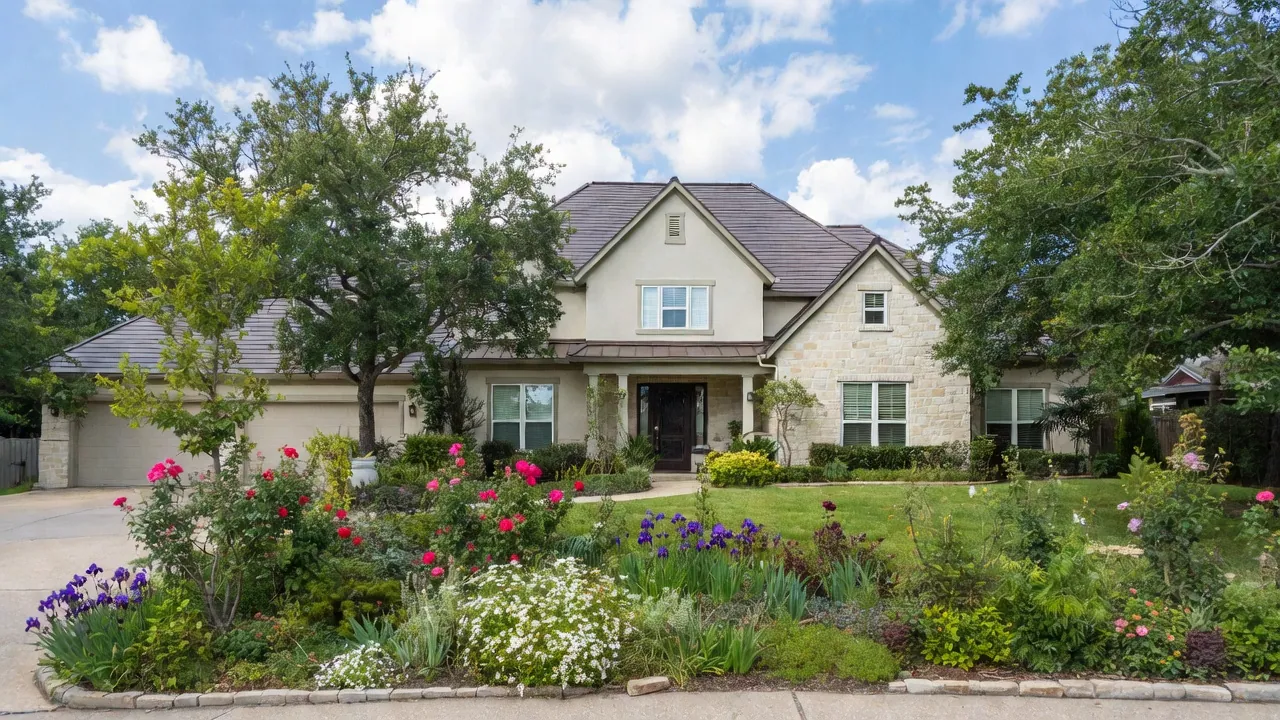
The daily rhythm of life in Magnolia is a study in suburban-rural synthesis. Observable patterns indicate a significant difference between weekday obligations and weekend leisure, driven by the geographic realities of the region.
On weekdays, Magnolia functions primarily as a high-mobility commuter hub. Residents in the 77354 and 77355 ZIP codes are predominantly car-dependent, with data indicating that a significant portion of the workforce travels over 45 minutes to reach employment centers.
Chrononutritional research suggests that residents in these expanding suburban/rural areas typically start their day earlier than urban counterparts, with the first food intake occurring earlier to accommodate long commutes toward Houston, Spring, or Conroe.
Mornings are characterized by high-volume traffic on FM 1488 and FM 1774 as students navigate toward MISD campuses.
Approximately 14% of the population in 77355 works from home, a trend that has significantly altered weekday patterns by increasing mid-day demand for local cafes like Sweetwaters Coffee & Tea and regional co-working hubs
On weekends, the focus shifts toward regional recreation and "slow living."
The housing stock in Magnolia is notable for its relative youth and the dominance of single-family structures. In 77354 and 77355, the majority of homes were constructed after 1990, with a massive surge in inventory appearing post-2010.
The MPC model is the current engine of growth in Magnolia. These developments are designed with high-density clusters of homes surrounded by preserved green belts.
A 3,000-acre project that epitomizes the "live-work-play" trend, featuring resort-style pools, nature-filled trails, and future mixed-use commercial sectors.
A newer 1,400-acre development planned for up to 3,700 homes, focusing on "traditional Texas charm" with modern amenities like the "Boothouse" community center.
Positioned as an entry-level to mid-market option, offering new construction homes starting in the high $200s, attracting a younger demographic of first-time homebuyers.
Large-tract homes in 77355 often feature detached workshops, equestrian facilities, and unrestrictive HOAs, catering to those with specific hobbyist or privacy requirements.
Neighborhoods like Thousand Oaks and Lake Windcrest feature custom-built estates on 1-plus acre lots, with home values frequently exceeding $1 million.
While 69% of the city's housing is single-family, the rental market is diversifying.3 The Villages of Magnolia offers luxury apartments and townhomes that mimic the "mansion" aesthetic, featuring attached garages and private driveways, targeting those who prefer the flexibility of renting without sacrificing the suburban feel.
| Housing Type | Target Demographic | Typical Price Range |
|---|---|---|
| MPC Single-Family | Young households / Move-up buyers | $290k – $550k |
| Custom Acreage | High-net-worth / Equestrian | $750k – $1.5M+ |
| Luxury Rental | Transitional / Relocating professionals | $1,800 – $2,500 / month |
The Magnolia market in late 2025 is undergoing a period of recalibration. After several years of aggressive appreciation, the market has transitioned into a "buyer-balanced" phase where inventory levels are rising and days on market (DOM) are extending.
| Metric (Dec 2025) | Magnolia (Overall) | ZIP 77354 | ZIP 77355 |
|---|---|---|---|
| Median Sale Price | $238,344 | $395,000 | $313,000 |
| Median List Price | $369,000 | $395,000 | $375,000 |
| Price per Sq. Ft. | $152 | $181 | $151 |
| Y-o-Y Price Change | -13.3% | +7.05% | -2.7% |
Note: The overall city median price is skewed lower by older, smaller stock within the 5.7 sq mile city limits, while the ZIP code data captures the higher-value master-planned growth in the extraterritorial jurisdiction (ETJ)
Pricing varies significantly by ZIP code, reflecting the different levels of development and proximity to regional hubs.
Market velocity has slowed considerably from the peak of 2022.
Historical data from the Houston Association of Realtors (HAR) shows that despite the current cooling, the long-term trend remains positive. Median prices in 77355 have risen from approximately $244,000 in early 2020 to their current levels, representing a compound annual growth rate that outperforms many closer-in Houston neighborhoods.
Education is the primary institutional anchor for the Magnolia community. The Magnolia Independent School District (MISD) serves as the main provider of public education, with its boundaries covering the majority of 77354 and 77355.
MISD is a PK-12 district with an enrollment of over 14,000 students. It is highly rated for its athletic programs and academic diversity.
The district graduation rate is 95%, with an average SAT score of 1043.
The district maintains a ratio of approximately 16:1, which is competitive for a fast-growing Texas district.
Magnolia’s growth has necessitated a continuous cycle of construction and rezoning.
The area is also home to several private institutions, catering to approximately 5% of the local student population.
Magnolia's infrastructure is currently in a state of rapid transition, moving from a rural service model to a suburban-commercial model.
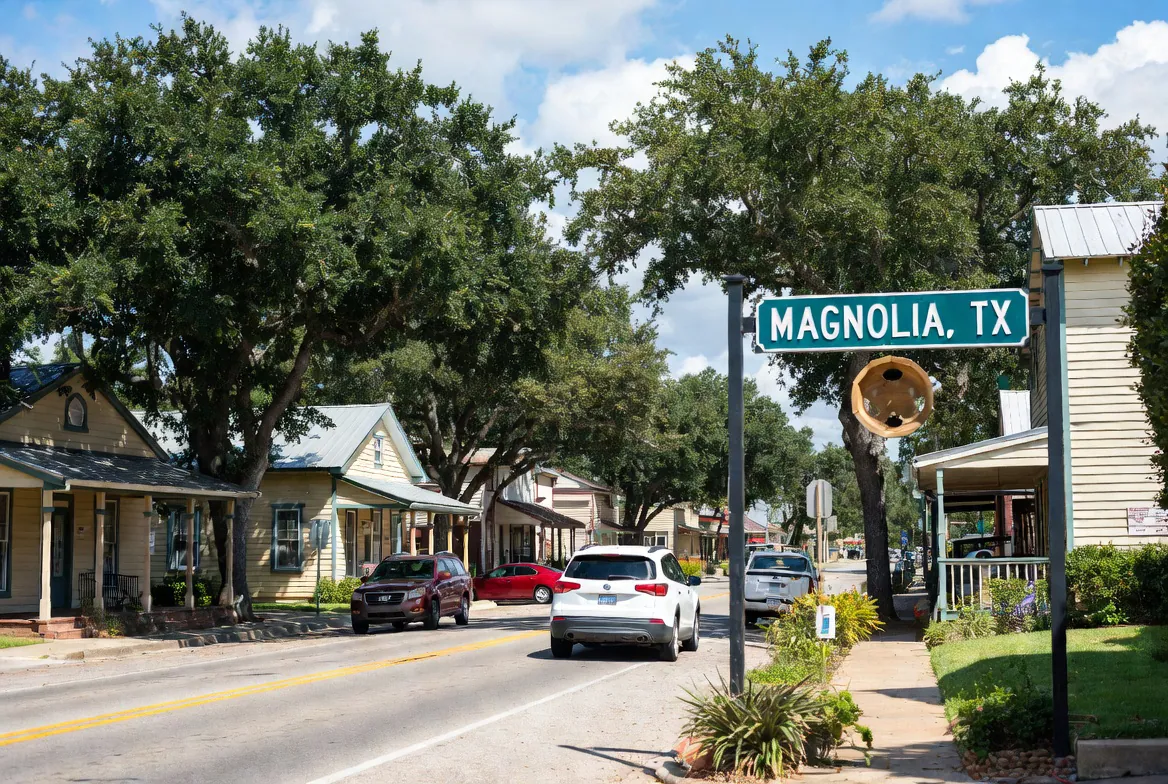
The retail landscape is concentrated along the FM 1488 corridor.
A 60-acre development that includes three 10,000-square-foot retail buildings and a 300-apartment complex. The project is attracting "daily needs" tenants, including F45 Fitness and 5Point Credit Union.
A fully occupied retail center featuring national and local brands like The Toasted Yolk, Anytime Fitness, and Sugar Llamas.
The site of a new 5,000-square-foot Chick-fil-A (expected Fall 2025), which serves as a bellwether for increased national commercial interest in the area.
This 30-acre sanctuary includes a 7,500-square-foot covered pavilion with a kitchen, a skateboard park, volleyball courts, and a splash pad.
Located just east on FM 1488, it offers miles of hiking and biking trails and serves as a major regional green space.
A local staple that has become a community social hub since its establishment in 2012.
The pace of residential growth has occasionally outstripped the city's utility capacity.
Magnolia’s job market is defined by a "hub-and-spoke" model, where the majority of residents commute to nearby employment cores while local service-based employment grows.
The local economy is anchored by institutional and service-based entitie
The regional commute is the primary "lifestyle cost" for Magnolia residents.
| Target Employment Hub | Distance | Avg. Commute Time (Rush Hour) |
|---|---|---|
| The Woodlands / ExxonMobil | 15–20 miles | 35–45 minutes |
| Tomball / Baker Hughes | 10–15 miles | 20–30 minutes |
| Cypress / Lone Star College | 18–22 miles | 40–50 minutes |
| Downtown Houston | 42–45 miles | 55–80 minutes |
While limited, the Sterling Ridge Park & Ride (The Woodlands Express) and the Cypress Park & Ride (METRO) serve as critical lifelines for downtown commuters. These options typically involve a 30-minute taxi or drive to the station, followed by a 40-60 minute bus ride into the city.
The demographic data for 77354 and 77355 describes a high-earning, educated population that is significantly younger than national retirement averages but older than urban core neighborhoods.
The region is heavily oriented toward multi-resident households.
Magnolia’s market position can be understood by comparing it to its primary regional competitors: Tomball, The Woodlands, and Waller.
Tomball is the more "urbanized" neighbor. It features more established infrastructure and a faster market velocity (46 days on market). However, Tomball has a higher median home price (~$383k) and lower inventory.6 Magnolia is the preferred choice for those prioritizing "more house for the money" and brand-new construction.4
The Woodlands is the regional luxury anchor. While The Woodlands offers world-class amenities, it also carries higher property tax rates in many segments and significantly higher entry-level home prices.15 Magnolia acts as a "pressure release valve" for The Woodlands, offering many of the same lifestyle benefits (access to nature, good schools) at a 20-30% discount on housing costs.4
Waller is the "frontier" alternative. Land in Waller is still being acquired for massive projects like the Ersa Grae twin communities.56 Waller currently offers a more rural feel and lower density, but it lacks the retail and school infrastructure that Magnolia has already developed. Movers to Magnolia are choosing "settled suburban" life, whereas Waller buyers are often early-adopters of the next growth wave.
The Magnolia neighborhoods of 77354 and 77355 attract specific resident profiles based on their professional and lifestyle behaviors.
In conclusion, Magnolia functions as a high-income, family-centric growth corridor that offers a distinctive "suburban-rural" synthesis. Its future trajectory is inextricably linked to its ability to resolve current water and traffic infrastructure constraints, but its fundamental appeal—value, education, and nature—remains a primary driver for northwest Houston migration.
Moving to Magnolia from out of state? Our relocation guide covers the villages, the three school districts, MUD and Township taxes, commute routes and a 90-day timeline.
Read the Relocation GuideMagnolia is a small city in southwestern Montgomery County, Texas, located along FM 1488 and FM 1774 about 40 miles northwest of downtown Houston. It sits west of The Woodlands and is served by the Magnolia Independent School District.
Magnolia is known for its small-town character, larger residential lots, and the Magnolia ISD — one of the highest-rated districts in the greater Houston area. The area attracts buyers seeking acreage and equestrian-friendly property within commute range of The Woodlands.
Magnolia real estate ranges from traditional single-family neighborhoods to large-acreage and ranch properties along FM 1488. Buyers commonly compare Magnolia against The Woodlands and Tomball when weighing space and schools against commute.